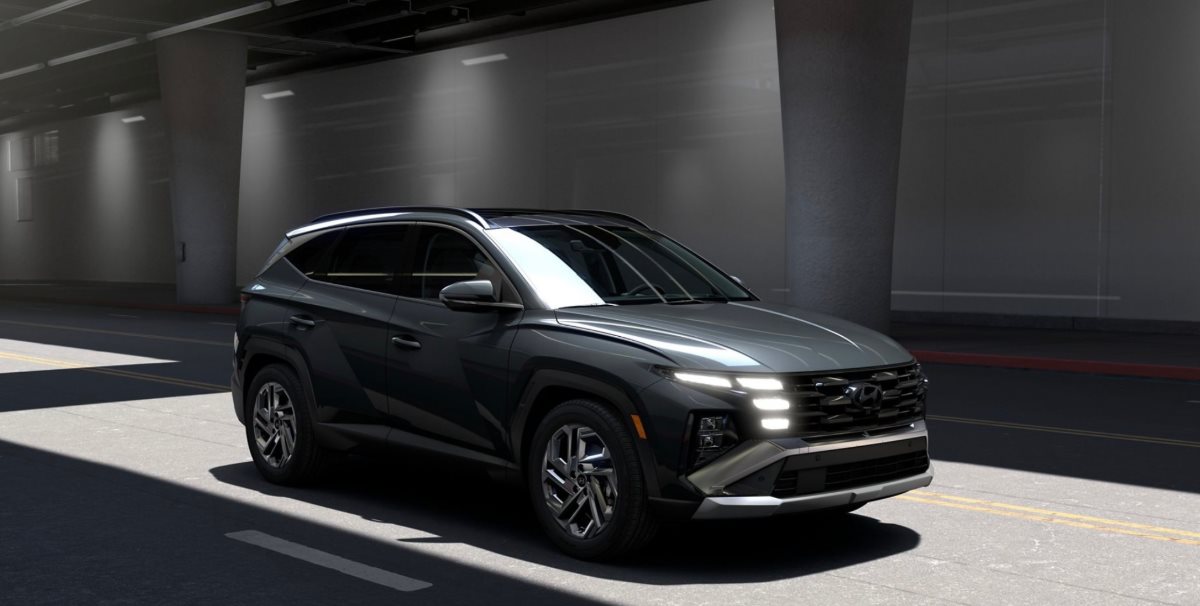
Tucson Hybrid vs Tucson Plug-in Hybrid: What's the Difference?
If you're shopping for a new Hyundai Tucson and want to go green without going full electric, you're likely staring down two compelling options: the Tucson Hybrid and the Tucson Plug-in Hybrid (PHEV). Both deliver impressive fuel economy, a sleek design, and Hyundai's signature tech — but they work very differently under the hood, and the right choice depends entirely on how you drive.
In this guide, we break down everything you need to know about the Tucson Hybrid vs. Tucson Plug-in Hybrid: how each system works, fuel economy, electric range, pricing, charging requirements, and which one makes the most financial and practical sense for your daily life.
How Each Powertrain Works
Before diving into the specs, it helps to understand the core difference between a standard hybrid and a plug-in hybrid.
Tucson Hybrid: Self-Charging Convenience
The Tucson Hybrid uses a parallel hybrid system that pairs a 1.6-liter turbocharged four-cylinder engine with an electric motor and a small lithium-ion polymer battery. The key word here is self-charging — you never need to plug it in. The battery replenishes itself through regenerative braking and the engine, making the Tucson Hybrid feel almost identical to driving a conventional SUV.
The electric motor assists the engine during acceleration and low-speed driving, reducing how hard the gas engine works and cutting fuel consumption in the process. At highway speeds or when the battery is full, the engine takes over entirely. The transition between power sources is seamless and invisible to the driver.
Tucson Plug-in Hybrid: Gas + a Real Electric Boost
The Tucson PHEV also uses a 1.6-liter turbocharged engine, but it's paired with a significantly larger battery — one that can be recharged by plugging into an external power source. This larger battery enables a meaningful electric-only driving range before the gas engine kicks in.
In everyday driving, if your trips are short enough, you may rarely use gasoline at all. For longer drives, the PHEV transitions into hybrid mode, functioning similarly to the standard Hybrid. It's the best of both worlds: pure electric driving for short trips, and unlimited range via the gas engine for road trips.
Electric Range: The Biggest Practical Difference
This is where the two models diverge most dramatically.
The Tucson Hybrid has a very limited electric-only range — in most situations, it cannot drive on electricity alone for any meaningful distance. The electric motor is a support system, not a standalone drive mode.
The Tucson PHEV, on the other hand, offers approximately 33 miles of all-electric range (EPA estimated). For many commuters in the United States — where the average one-way commute is around 16 miles — that means you could potentially do your entire daily round-trip commute without burning a single drop of gasoline.
If you charge overnight at home and again at work, you could theoretically go weeks without visiting a gas station during your regular routine. This is the PHEV's biggest selling point and the reason many drivers find it worth the additional upfront cost.
Fuel Economy: How Efficient Is Each Model?
Both the Tucson Hybrid and the Tucson PHEV are impressively efficient, but the metrics used to measure them differ.
Tucson Hybrid Fuel Economy
The Tucson Hybrid delivers an EPA-estimated 38 mpg combined (approximately 38 city / 38 highway in front-wheel drive configuration). This makes it one of the more efficient compact SUVs in its class. You'll see real-world efficiency that mirrors these numbers closely in mixed driving conditions.
Tucson PHEV Fuel Economy
The Tucson PHEV is rated at approximately 80 MPGe (miles per gallon equivalent) when operating in electric mode. Once the battery is depleted, it returns around 35 mpg combined in hybrid mode — slightly less than the standard Hybrid due to the added weight of its larger battery pack.
The bottom line: if you charge regularly and keep trips within the electric range, the PHEV can be dramatically more efficient and cheaper to "fuel" than the standard Hybrid. If you rarely charge it, you'll get slightly worse gas mileage than the standard Hybrid, so charging habits matter enormously with a PHEV.
Charging the Tucson PHEV
One of the most important considerations when choosing the Tucson PHEV over the standard Hybrid is your ability to charge conveniently.
Level 1 Charging (Standard Outlet)
You can plug the Tucson PHEV into a standard 120-volt household outlet using the included Level 1 charging cable. This is the slowest option — expect a full charge to take around 9–12 hours from empty. It works if you plug in overnight every night, but it doesn't leave much margin for error.
Level 2 Charging (Home Charger)
For most PHEV owners, a Level 2 home charging station (240 volts) is the practical choice. With a Level 2 charger, the Tucson PHEV can fully recharge in approximately 2 hours. Home Level 2 chargers typically cost $300–$800 for the hardware plus installation, though federal and state tax incentives may offset this cost.
Public Charging
The Tucson PHEV is compatible with Level 2 public chargers, which you'll find at many workplaces, parking garages, shopping centers, and charging networks like ChargePoint and Blink. It does not support DC fast charging, which means you won't be able to use the ultra-rapid chargers typically associated with fully electric vehicles.
The standard Tucson Hybrid, of course, requires no charging infrastructure whatsoever — a significant lifestyle simplification that some buyers genuinely prefer.
Where to Charge Your EV Near Hamburg, PA
If you're considering a Tucson PHEV and live or work in the Hamburg, PA area, you'll be pleased to know that public charging options are readily available. Here's a breakdown of the nearest stations:
In Hamburg (Fast Charging)
- Tesla Supercharger at Wawa — 515 Lowland Rd, Hamburg, PA 19526. The best fast-charging option in town, featuring 8 Superchargers with speeds up to 250 kW. Open 24/7 and accessible to non-Tesla vehicles with a compatible adapter. Conveniently located at a Wawa with clean restrooms and food options while you wait. (Rated 4.2★)
- EVgo Charging Station — 1565 W Beaver St, Hamburg, PA 19526. Located near the Kelly Hyundai dealership, this is a convenient stop for local drivers. Open 24/7.
In Hamburg (General Charging)
- Electric Charging Station — 900 S 4th St, Hamburg, PA 19526. A public charging spot known for its user-friendly technology and easy access.
- Rutter's — 100 Grand St, Hamburg, PA 19526. This 24/7 convenience store and truck stop offers outdoor plugs located around the building's perimeter. Just request permission at checkout before plugging in.
Nearby Alternatives (Within 15 Miles)
- Tesla Supercharger at Vraj Temple — 51 Manor Rd, Schuylkill Haven, PA 17972 (~10 miles away). A Supercharger located on the scenic grounds of the Vraj Hindu Temple. Open daily 7 AM–7 PM.
- Blink Charging Station at St. Luke's Orwigsburg — 1165 Centre Turnpike, Orwigsburg, PA 17961 (~11 miles away). Open 24/7. A solid backup option when Hamburg stations are busy.
Between home charging overnight and these conveniently located public stations, Hamburg-area Tucson PHEV drivers have everything they need to stay charged and save on fuel costs year-round.
Performance Comparison
Both models share the same 1.6-liter turbocharged base engine, but their total system output differs due to their electric components.
- Tucson Hybrid: Combined system output of 226 horsepower, paired with HTRAC all-wheel drive (standard on higher trims).
- Tucson PHEV: Combined system output of 261 horsepower, giving it a noticeable edge in acceleration and towing capability.
The PHEV's higher horsepower makes it feel punchier off the line, particularly useful in highway merging or when fully loaded. If performance is a priority alongside efficiency, the PHEV has the edge. Both models offer smooth, composed handling consistent with Hyundai's well-regarded ride quality in the Tucson lineup.
AWD availability also differs: the Tucson Hybrid offers HTRAC AWD as a selectable option depending on trim, while the Tucson PHEV comes standard with AWD on most configurations — an important consideration for buyers in snowy or mountainous regions.
Pricing: What Does Each Model Cost?
As expected, the plug-in hybrid commands a premium over the standard hybrid.
Tucson Hybrid Pricing
The Tucson Hybrid starts at approximately $33,000 MSRP for the base Blue trim and climbs to around $42,000+ for top-tier Limited trim levels. The price positioning makes it a competitive value in the hybrid SUV segment.
Tucson PHEV Pricing
The Tucson PHEV starts at approximately $36,000 MSRP and reaches into the mid-$40,000 range at higher trims. The initial price difference versus the standard Hybrid is roughly $3,000–$5,000, depending on trim level.
Federal Tax Credits
This is where the PHEV's financial case gets interesting. The Tucson PHEV may qualify for a federal EV tax credit under the Inflation Reduction Act (IRA), potentially up to $3,750 for eligible buyers, depending on income limits and whether the vehicle meets domestic manufacturing requirements. Check the current IRS guidelines and Hyundai's eligibility status before purchasing, as these rules evolve.
The standard Tucson Hybrid does not qualify for federal EV tax credits, since it cannot be plugged in.
Additionally, many states offer their own incentives for PHEVs in the form of rebates, reduced registration fees, or HOV lane access — benefits that can add up significantly over time.
Total Cost of Ownership
When evaluating which model makes more financial sense, it's worth thinking beyond the sticker price.
Fuel savings with a PHEV can be substantial. Electricity typically costs far less per mile than gasoline. If your electricity rate is around $0.14/kWh and you're driving on electric power for 30 miles a day, you might spend less than $1.50 on that commute. The same trip in the standard Hybrid at 38 mpg and $3.50/gallon gasoline would cost around $2.75. The savings accumulate quickly for high-mileage commuters.
Maintenance for both models is generally lower than that of conventional gas vehicles due to regenerative braking (which reduces brake wear) and reduced engine strain. The PHEV may have slightly higher long-term battery replacement costs in theory, though modern PHEV batteries are covered by Hyundai's 10-year/100,000-mile battery warranty.
Insurance costs are typically similar between the two, though some insurers charge marginally higher premiums for PHEVs due to replacement parts costs.
For most drivers who charge regularly, the Tucson PHEV pays for its premium within 2–4 years through fuel savings and tax incentives, assuming they maximize electric driving.
Which One Is Right for You?
Here's a simple framework to help you decide:
Choose the Tucson Hybrid If:
- You want maximum simplicity — no charging required, ever
- Your driving is primarily highway miles where gasoline is most efficient
- You don't have easy access to home charging (apartment, street parking, etc.)
- You want a lower upfront cost without compromising on fuel economy
- You take frequent long road trips where charging availability is uncertain
Choose the Tucson PHEV If:
- You have a predictable daily commute under 35 miles
- You can charge at home overnight, at work, or both
- You want to minimize gas station visits and fuel costs
- You want to qualify for federal and state EV incentives
- You prioritize stronger performance (261 hp vs. 226 hp)
- You need AWD as a standard feature
The sweet spot for the PHEV is the suburban commuter who drives 20–40 miles daily, charges at home, and wants to feel like an EV driver most of the time — with the security blanket of a gas tank for longer hauls.
Key Differences at a Glance
| Feature | Tucson Hybrid | Tucson Plug-in Hybrid |
|---|---|---|
| Electric-only range | Minimal (support only) | ~33 miles (EPA est.) |
| Fuel economy (combined) | ~38 mpg | ~80 MPGe / ~35 mpg hybrid |
| System horsepower | 226 hp | 261 hp |
| Charging required | No | Yes (Level 1 or Level 2) |
| Starting MSRP | ~$33,000 | ~$36,000 |
| Federal tax credit eligible | No | Potentially up to $3,750 |
| AWD | Optional | Standard (most trims) |
| Battery warranty | 10 yr / 100,000 mi | 10 yr / 100,000 mi |
Final Verdict
Both the Tucson Hybrid and the Tucson Plug-in Hybrid are excellent vehicles that represent Hyundai at its best — refined, well-equipped, efficient, and competitively priced. The choice between them comes down to one central question: can you charge regularly?
If yes, the Tucson PHEV is a compelling value proposition. You get more power, meaningful all-electric driving, and the potential for significant fuel and tax savings that can offset the higher purchase price within a few years.
If no — or if charging feels like one more thing to manage — the Tucson Hybrid is a genuinely outstanding choice. It's efficient, capable, and requires nothing more than the occasional fill-up.
Either way, you're getting one of the best hybrid SUVs on the market. The hardest part is choosing just one.
Visit Kelly Hyundai of Hamburg — Serving Reading, Lehigh Valley, Orwigsburg & Allentown
When you're ready to experience the Tucson Hybrid or Tucson Plug-in Hybrid for yourself, Kelly Hyundai of Hamburg is your destination. As Pennsylvania's #1 Hyundai dealer, we proudly serve drivers across Reading, Lehigh Valley, Orwigsburg, Allentown, and the surrounding communities — so whether you're searching for Hyundai dealers near me or making the trip from across the region, our team is here to make the process easy, transparent, and rewarding.
At Kelly Hyundai of Hamburg, we carry a full inventory of Tucson Hybrid, PHEV, and used Tucson models across all trim levels, and our knowledgeable staff can walk you through every difference — from electric range and charging options to available incentives and financing. We'll also make sure you understand every aspect of the industry-leading Hyundai warranty, including the 10-year/100,000-mile powertrain coverage and 5-year/60,000-mile new vehicle limited warranty that comes standard on every new Tucson. That's the kind of long-term peace of mind you simply don't find everywhere. Contact us today to learn more about available Hyundai Tucson models near you!
Stop in for a test drive, explore our current specials online, or give us a call — we'd love to help you find the Tucson that fits your life and your commute perfectly.